
Dr. Michael Warren practices primary care through public policy
Each time Dr. Michael Warren '03 travels I-95 from Washington, D.C. to his hometown of Newton Grove, N.C., he sees the signs for Greenville and two thoughts cross his mind...
Each time Dr. Michael Warren '03 travels I-95 from Washington, D.C. to his hometown of Newton Grove, N.C., he sees the signs for Greenville and two thoughts cross his mind - what would have happened if East Carolina University hadn't been there and what if the Brody School of Medicine hadn't been established in eastern North Carolina.
"Because ECU is there, there are so many people across the eastern part of the state that get care who wouldn't have gotten it otherwise or wouldn't have gotten [as high quality] care," Warren said. "It's just such a special place."
Warren understood the influence ECU and Brody had in eastern North Carolina and experienced the impact firsthand when he enrolled in medical school to become a primary care pediatrician.
Growing up in a rural community, he gained an understanding of the need for primary care physicians and the importance of ensuring that there were well-trained clinicians providing care for people in eastern North Carolina.
"Oftentimes, people who aren't from [eastern North Carolina] forget about it. There's a whole part of the state, east of I-95, and those are my people," Warren said. "That's where I'm from. And they're people that I care about."
Warren said that from the time he knew he wanted to be a physician, he also knew he wanted to be a pediatrician. All the signs directed him to Brody.
"If you want primary care, ECU is always at the top of that list, and if you want to do primary care in eastern North Carolina, there's just nowhere else that compares to Brody," he said. "I was always super excited about the opportunity."
OPENING DOORS FOR MEDICAL STUDENTS
This year, Warren pledged gifts through the ECU Health Foundation that will help Brody and support future medical students.
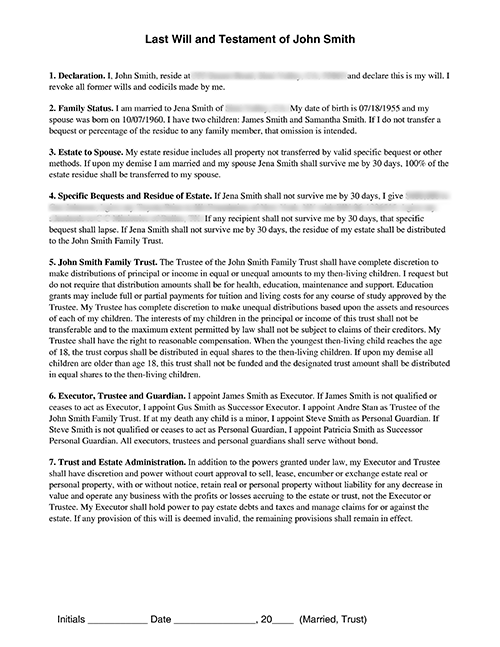
He established a Retirement Plan Beneficiary Designation supporting the Dale and Janet Warren Scholarship Endowment. His initial gift in 2016, with a matching contribution from the ECU Medical and Health Sciences Foundation board, established the scholarship endowment.
ECU will receive approximately $250,000 from Warren's retirement after his death, potentially creating more or larger scholarships for Brody students.
The endowment is one way Warren has chosen to honor and celebrate his parents, Dale and Janet. Warren said the scholarship, and naming it after them, is a way to honor the part they played in his journey to becoming a physician.
"Neither of them went to college. They both went to work straight out of high school. My journey has been, and continues to be, very different from theirs, but they've never faltered in supporting me on my journey," Warren said. "They just 100% supported me through all of that."
Warren said without his parents' support, he would not have attended Wake Forest University or medical school. At Brody, he received scholarships to help alleviate the burden of debt.
Giving back and being of service to others is a lesson he and his brother learned from their parents' example. "That notion of just giving back, it's part of what we do. I feel like it's kind of in my DNA," he said. "They've always modeled that for us."
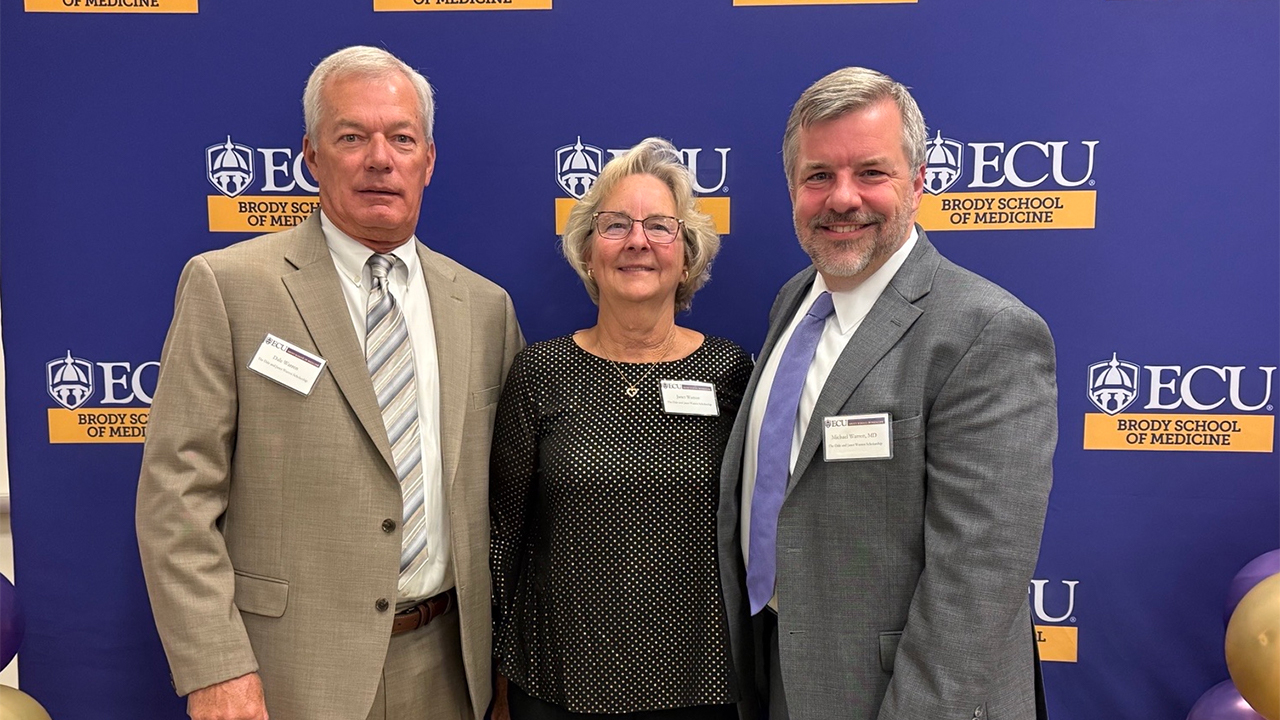
Since creating the endowment, Warren has been able to attend scholarship events with his parents and share in seeing the impact of the scholarships.
"I love seeing mom and dad be so excited about the students and knowing that they've got a part in that student's educational journey and giving back," Warren said. "This is another way that I can say thank you to them and that they get to be a part of that [scholarship experience]."
STATE-OF-THE-ART TRAINING
Warren has pledged an additional $50,000 gift over the next four years in support of the new Center for Medical Education (CME) at Brody. These funds will be part of the Brody School of Medicine Educational Excellence Endowment. The Medicine Educational Excellence Endowment is a multi-donor fund focused on elevating the student experience through enriched educational programming.
Warren's gift will be honored as part of the pediatric simulation suite in the CME. He is excited about all the enhancements that are planned for the CME, particularly the simulation lab for pediatrics.
"I loved the Brody building, and I am excited to see that folks who are coming later are going to have a new space that's a state-of-the-art space," he said. "The pediatric piece was near and dear to my heart, especially the simulation work."
IMMERSIVE LEARNING
Lessons from Brody influence the long arc of Warren's career as a physician. At Brody, he felt a sense of community and was provided with vast opportunities to learn in the classroom and beyond.
"From the front door until the day I graduated, there was always this sense that people really cared that we were there and wanted to make sure we were successful," Warren said. "When I left there at the end of four years, I really felt like I was leaving family. There is a strong sense of connectedness and community that I felt there."
Warren recalls being amazed at the breadth of things, including uncommon medical issues, he saw as a medical student, particularly during clinical training.
"One of the things that I think Brody did really well was during your clinical clerkship years, you would often go out to community practices," Warren said. "I was doing my pediatrics rotation, and I did a two-week stint in Williamston and got to spend time with a community pediatrician there. I remember really, really uncommon conditions that I saw in his practice. I remember to this day things I'd only previously seen on slides or in textbooks, but they were right there in Williamston."
Warren graduated from Brody and began his residency at Vanderbilt, where he became more convinced of his plans to be a primary care clinician. He planned to follow the signs back to eastern North Carolina, where he would serve as a pediatrician in rural Sampson County.
"As much as I loved primary care, there were things that were keeping my patients from being healthy that I couldn't fix in a 15 or 20-minute clinic visit - things like having adequate health insurance and having safe and stable housing," Warren said. "I found that I was drawn to these broader public health and policy issues, even while I was still really loving primary care."
At Vanderbilt, Warren completed a fellowship in academic general pediatrics and earned a master's degree in public health as part of that work. He balanced his time between practicing as a pediatrician and working on public policy focused on maternal and infant health outcomes. His career map began to shift away from clinical work.
SUPPORTING HEALTH WITH PUBLIC POLICY
His three-year residency turned into a 15-year overall stay in Nashville, during which time he became the state maternal and child health director for the Tennessee Department of Health.
"It seemed like a great opportunity to bring my clinical experience in pediatrics, the experiences I'd had at Brody and understanding some of those community factors that influence health," he said. "It was a job that would allow me to bring all those things together."
Warren eventually became the department's deputy commissioner with a portfolio that included maternal and child health, chronic disease, rural health, minority health, population health statistics and the office of the state chief medical examiner. While he loved the role, it limited the time he was able to focus primarily on health disparities that impact maternal and child health.
Warren's public policy work took him to Washington in 2018, where he began a career position with the U.S. Department of Health and Human Services (DHHS) as Associate Administrator, Maternal and Child Health Bureau, Health Resources and Services Administration.
In that role, Warren led the federal Maternal and Child Health Bureau, a $1.7 billion organization with 300 staff, which primarily supported health block grants that go to every state, including North Carolina, and other public health grant programs to support things like home visiting, emergency medical services for children, specialized programs for children with autism or sickle cell disease, and also public health infrastructure grants.
MARCHING FORWARD
Following a change in initiatives at DHHS, Warren's job was reassigned and he began looking for a job where he could make a difference for mothers and babies, as well as address population health issues. He became the chief medical and health officer for the March of Dimes and is back at work elevating maternal and child health.
"I feel so incredibly fortunate that this opportunity opened up with March of Dimes," Warren said. "I can wake up every day thinking about moms and babies and what their needs are, what we can do and who we can partner with." He and his colleagues are also learning how to engage policymakers to ensure that, at both the state and federal levels, lawmakers are making the best decisions for mothers and babies.
The March of Dimes was founded in 1938 by President Franklin D. Roosevelt at the height of the polio epidemic.
"Our name, in fact, comes from those early campaigns where people across the country sent in their dimes to DC and the money went into the race to develop a vaccine for polio," Warren said.
Warren said there continues to be great need for both maternal and infant health to improve. For his part, he and his team aim to fill the gaps and respond to health disparities from eastern North Carolina to the coast of California.